
The Evolution of Meta Advertising: A Complete Guide to the Andromeda Era
How Meta's Latest Algorithm Update Is Reshaping Campaign Structure and Why Creative Quality Now Determines Everything
The landscape of Meta advertising has undergone a dramatic transformation. What began as complex, multi-layered funnel strategies has evolved into something remarkably simpler—yet paradoxically more demanding. The latest shift, known as "Andromeda," represents the culmination of years of algorithmic advancement and fundamentally changes how successful advertisers approach the platform.
Understanding Meta's Current Position in the Advertising Ecosystem
Despite frequent complaints about low CTRs, high CPCs, and inflated CPAs, Meta remains the world's premier platform for acquiring high-converting traffic at scale.
The platform enables advertisers to generate six-figure daily revenue with minimal overhead—no specialized media buyers, no programmatic expertise, no bot traffic concerns. However, success in the Andromeda era hinges on a single critical factor: exceptional creative execution.
This guide breaks down how Meta advertising has evolved, what the Andromeda structure means for your campaigns, and how to adapt your strategy for maximum performance.
The Five Phases of Meta Advertising Evolution
Understanding how Meta advertising has evolved is essential for grasping why Andromeda represents such a significant shift in strategy.
Phase 1: The Funnel Era (2015-2017)
Early Meta advertising borrowed heavily from Google and Yahoo strategies, requiring advertisers to build complex three-tier funnels:
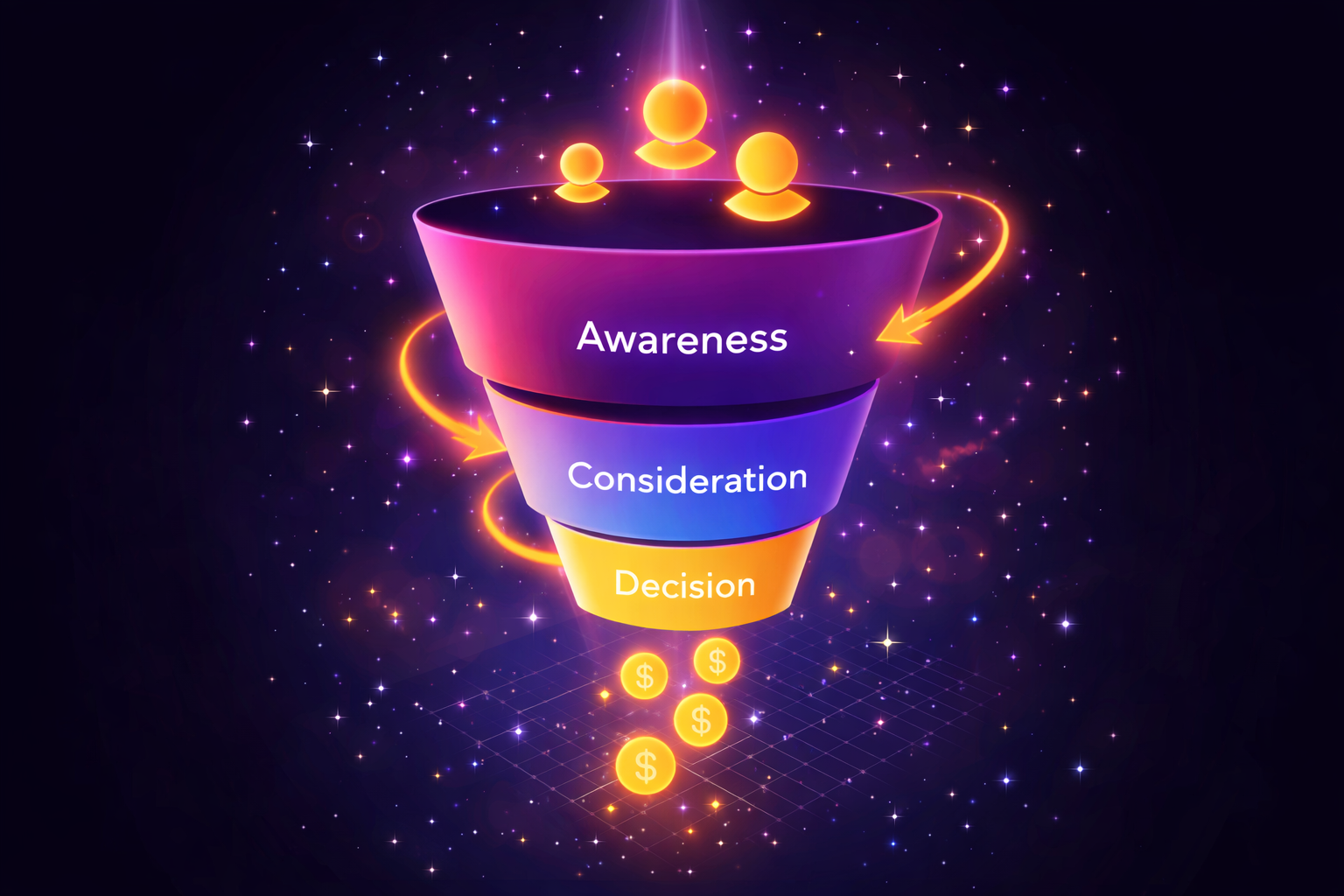
- Top of Funnel (ToF): Prospecting campaigns, often starting with lower conversion goals like Add to Cart or Initiate Checkout to help the algorithm learn
- Middle of Funnel (MoF): Warming traffic and directing users to product detail pages
- Bottom of Funnel (BoF): Retargeting abandoned carts and checkout visitors
This approach required significant manual management and funnel optimization.
Phase 2: The Simplification Phase (2018-2020)
As Meta accumulated billions in ad spend data across its platform, the algorithm became sophisticated enough to leverage collective learning. Campaigns could benefit from prospecting work performed by other advertisers, effectively eliminating the need for extensive top-of-funnel warming.
The consideration funnel collapsed, allowing advertisers to achieve results with simpler campaign structures.
Phase 3: The Broad Targeting Takeover (2020-2024)
This period marked a significant turning point: broad campaigns began consistently outperforming even well-optimized lookalike audiences built from tens of thousands of customers. Meta's automatic targeting evolved from a convenient option to the superior strategy.
Advertisers could scale from $5K-$10K daily to $50K-$100K daily using Meta's automatic targeting. Advantage+ campaigns delivered strong performance from day one, relying on Meta's cross-advertiser data intelligence.
Phase 4: Enter Andromeda (2025-Present)
The Andromeda structure represents the ultimate simplification in Meta advertising—and simultaneously the most demanding test of creative quality.
Traditional Campaign Structure (Pre-Andromeda)
Before Andromeda, most high-performing accounts operated with three distinct campaign types:
- Lowest Cost Campaign: General spend around $20K/day
- Testing Campaign: ABO structure with new ad sets to test creative angles
- Scale Campaign: Unlimited budget ($500K+/day) with strict bid caps
The Andromeda Revolution
Andromeda eliminates the need for separate testing campaigns entirely. Here's the structure:
One CBO campaign. One ad set. All your ads.
That's it.
Understanding the Industry Shift
The introduction of Andromeda has created significant disruption across the advertising industry. Traditional agency models built on campaign complexity and manual optimization are being challenged.
However, the narrative that "advertising is getting easier" misses the point. While Meta's AI advancement reduces manual scaling work, the fundamental challenge has shifted rather than disappeared.
How Andromeda's Creative Filter Works
Understanding Andromeda's creative filtering mechanism is crucial for campaign success. The system operates on a fundamental principle: if your ad doesn't receive impressions, the algorithm has determined it doesn't merit distribution—not that it needs more testing budget.
The Old Testing Model's False Validation
In pre-Andromeda structures, advertisers could launch mediocre ads in separate campaigns with dedicated $1,000/day budgets. These ads would generate spend by capturing retargeting audiences—low-hanging fruit that would validate creative even when it didn't deserve validation.
The Andromeda Reality
Andromeda eliminates this self-deception mechanism. When you launch multiple creative variations and they receive minimal impressions after a week, Meta is providing clear feedback: the creative quality doesn't meet the platform's performance threshold.
This applies regardless of creative volume. Launching 1,000 AI-generated variations won't outperform an advertiser running two high-quality ads launched a month ago. Meta now prioritizes quality over quantity.
Learning from TikTok's Quality-First Approach
TikTok pioneered the quality-first advertising model that Meta is now adopting. On TikTok, subpar creative simply doesn't receive spend allocation—the platform refuses to distribute low-quality ads regardless of budget.
Notably, the most successful Meta advertisers in 2025 are those who previously mastered TikTok advertising, having already learned to prioritize creative quality over volume.
Strategic Framework for Success in the Andromeda Era
Success in the Andromeda era requires abandoning volume-based creative strategies in favor of quality-focused development. Here's the framework that drives results:
1. Invest in Deep Customer Research
Move beyond surface-level demographics. Successful campaigns require granular understanding of customer motivations, pain points, and decision-making processes. Generic AI-generated insights lack the nuance needed for breakthrough creative.
That’s where Blumpo (try on ⇒ https://blumpo.com/) changes the game. Blumpo analyzes your website alongside real customer conversations from Reddit to extract authentic language, unmet needs, and hidden objections. It then translates those signals into ads built across 6+ customer archetypes — each with its own angle, framing, and emotional hook — so your communication portfolio expands in meaning, not just in volume.
Instead of one-size-fits-all personas, you get multiple creative lenses on the same product, grounded in how people really talk and decide.
2. Identify Untapped Angles
Competitive advantage comes from angles competitors haven't explored. While most advertisers recycle insights from spy tools, top performers invest time analyzing market gaps and developing original positioning. Developing differentiated angles is critical, especially in the era of AI-generated creative. We cover this in more detail in our AI ads creative landscape guide.
Key insight: Avoid asking AI tools like ChatGPT or Gemini for creative angles - they produce generic recommendations based on common patterns, not competitive differentiation. We explore this limitation in more detail in our guide on whether ChatGPT can actually create effective ads.
3. Prioritize Diversity Over Quantity
The fundamental principle: One low-production-value video with a novel angle for an untapped niche, launched monthly, will outperform 1,000 daily ads with recycled angles.
This represents a complete reversal from previous Meta advertising wisdom, which emphasized high creative volume and rapid testing. Way more important then quantity of ads is the diversity of angles. Running the same creative for too long often leads to ad fatigue in paid campaigns, gradually reducing CTR and increasing CPA. You can expand that narrative range by adding Blumpo AI ads to your creative mix - generating broader, higher-signal communication that stays aligned with Andromeda’s premium targeting.
4. Develop Genuine Differentiation
Eliminate the practice of paying budget editors $50 for quick-turnaround ads designed merely to maintain launch quotas. Instead, allocate time for developing truly differentiated creative concepts.
The Andromeda algorithm rewards thoughtful differentiation far more than rapid iteration.
The AppLovin Factor
While we're discussing platform evolution, AppLovin deserves mention. They've essentially recreated what Meta achieved in 2018, with an interesting twist: they're directing your traffic to top-of-funnel audiences initially generated by your competitors.
Imagine targeting people who just viewed Nike's running socks page but didn't purchase—for your running sock offer. For some campaigns, AppLovin is already delivering 30% of traffic volume. It's worth exploring as a complement to your Meta strategy. For a deeper breakdown, see our AppLovin platform overview and advertising costs guide.
Implementation Roadmap
Transitioning to the Andromeda structure requires strategic planning and a fundamental shift in creative development processes.
Immediate Action Steps:
- Audit current campaign structure - Consolidate multiple testing campaigns into the single CBO/single ad set Andromeda framework
- Evaluate creative quality - Remove underperforming ads that aren't receiving organic impression distribution and ensure your creatives follow the recommended Meta ad formats and sizes.
- Restructure creative development - Shift resources from high-volume production to deep research and angle development
- Establish quality benchmarks - Monitor which creative approaches receive natural algorithm distribution
- Reduce creative volume - Focus creative team efforts on fewer, higher-quality concepts
The Core Principle
Meta's algorithm has reached a sophistication level where it instantly identifies winning creative—provided the creative quality merits promotion. The platform hasn't become more difficult; the requirements have simply changed.
Success in the Andromeda era isn't about working harder through increased creative volume. It's about working strategically by developing genuine creative insights that the algorithm recognizes as valuable to users.
The question facing advertisers isn't whether Meta advertising works—the platform remains the premier traffic source for scaling performance campaigns. The question is whether your creative strategy has evolved to meet the algorithm's new quality requirements.