
The Difference Between Branding Ads and Performance Ads: Why You Need Both
How Branding Drives Conversions, Why Creative Diversity Matters, and the Strategic Balance That Scales B2B Growth
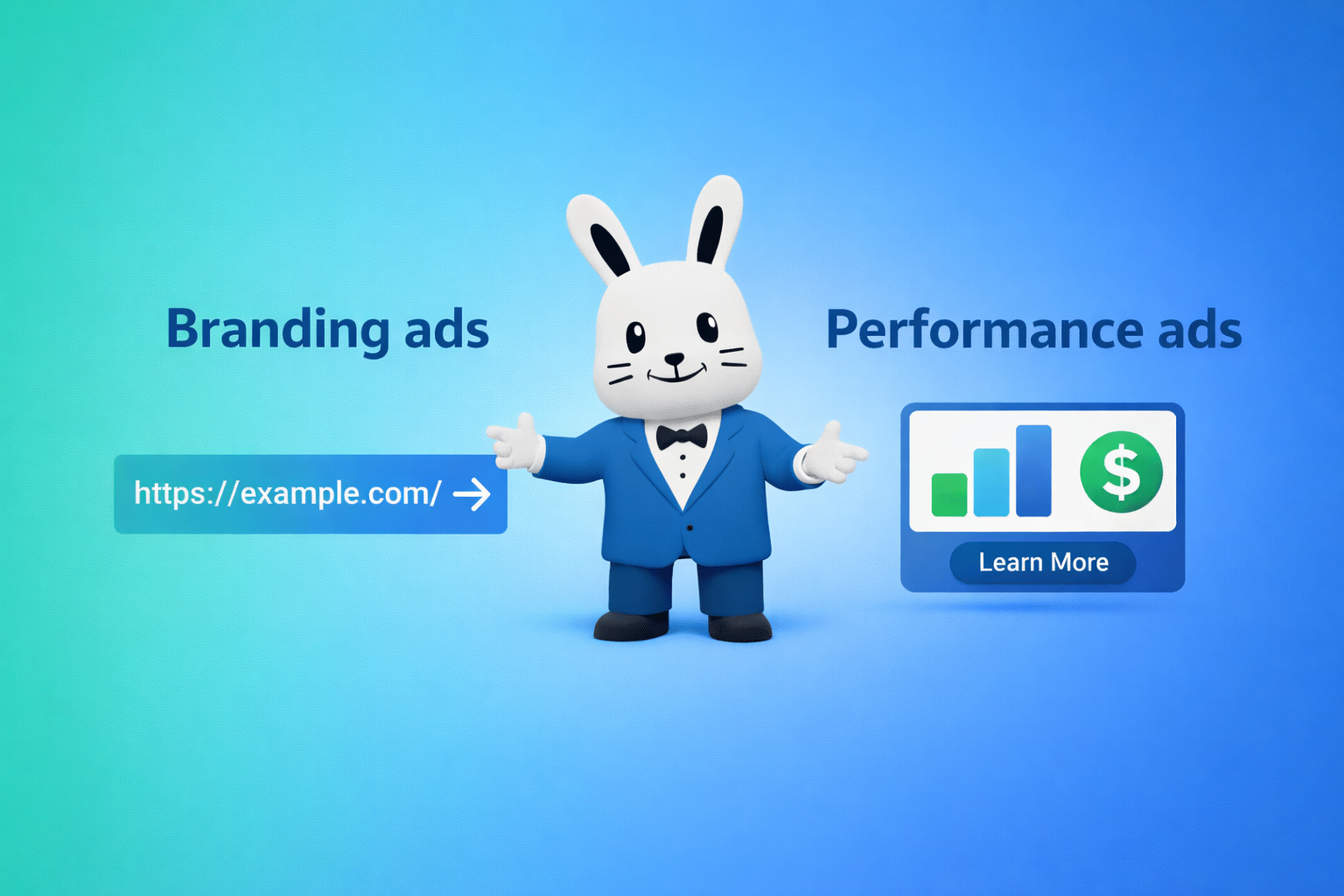
If you've ever felt torn between running ads that build your brand and ads that drive immediate conversions, you're not alone. Here's the truth that top-performing companies already know: branding ads and performance ads aren't competing strategies. They're complementary forces that, when balanced correctly, create exponential growth.
Let's break down what makes each type unique, why diversity in your ad strategy matters, and how branding actually drives the performance ads that scale your business.
What Are Performance Ads?
Performance ads are designed with one goal: drive immediate, measurable action.
Characteristics: Clear call-to-action (Sign up, Book a demo, Download), specific targeting based on user intent, focused on bottom-of-funnel prospects, optimized for metrics like cost-per-acquisition and conversion rate, direct response messaging.
Example: "Stop wasting 10 hours a week on manual data entry. Try our automation tool free for 14 days. No credit card required."
Performance ads are tactical. They capture demand that already exists and live or die by their conversion metrics.
What Are Branding Ads?
Branding ads create awareness, shape perception, and build mental availability - the likelihood that someone thinks of your brand when they have a problem you solve.
Characteristics: Focus on company values, mission, or positioning, broader targeting to reach potential future customers, less emphasis on immediate conversion, metrics include reach, brand lift, and awareness, messaging that creates emotional connection or memorable associations.
Example: "The tools you use should make you feel like a genius, not an idiot." (No specific CTA, just positioning)
Branding ads are strategic. They create demand rather than capture it.
The Critical Misconception: Performance vs. Branding
Here's where most B2B companies go wrong: they treat branding and performance as an either/or choice. "We're focused on growth, so we only run performance ads." Or conversely, "We need brand awareness, so we're doing a branding campaign."
This binary thinking ignores a critical reality: branding ads drive conversions. Not immediately, not directly - but powerfully.
How Branding Drives Performance
Think about how you make B2B purchasing decisions. When you see an ad for a tool you've never heard of, your first instinct is skepticism. Who are they? Can I trust them?
Now imagine seeing that same company's ads multiple times over several weeks - not all conversion-focused, but showcasing their mission, approach, and personality. By the time you see their performance ad with a free trial offer, you're not seeing a stranger. You're seeing a brand you recognize.
This is why branding ads are critical to scaling performance ads. As you increase performance ad spend, your cost per acquisition typically increases - you've captured the low-hanging fruit and are reaching colder audiences. Without branding, these colder audiences won't convert efficiently.
But with consistent branding creating familiarity and trust? Your performance ads work harder. The same creative that got a 2% conversion rate cold can get 5% or 8% when shown to people who've seen your brand before.
The Scaling Paradox
Here's what companies like Revolut, Lovable, and ElevenLabs understand: the more you spend on performance ads, the more you need to spend on branding.
Revolut didn't scale to millions of users just by running "Sign up now" ads. They invested heavily in branding that positioned them as the challenger to traditional banking, building trust at scale before asking for conversions. Lovable combines product showcase with brand personality, creating recognition that makes their performance ads more effective. ElevenLabs built massive awareness around AI voice technology through branding that educated the market.
The pattern is clear: successful scaling requires increasing brand investment alongside performance spend. You need to warm up the audiences that your performance ads will eventually target.
The Critical Role of Diversity in Ad Strategy
Diversity isn't just a buzzword - it's a tactical necessity in modern ad campaigns. But we're not talking about diversity in a social sense. We're talking about creative diversity: the variety of messages, formats, angles, and tones you deploy across your campaigns.
Why Diverse Ad Creative Matters
1. Algorithm Fatigue: Ad platforms penalize repetitive creative. Show the same ad too many times, and your CPMs increase while conversions drop - a classic symptom of ad fatigue that modern campaigns must actively manage. Diversity keeps campaigns fresh and costs efficient.
2. Audience Segmentation: Different prospects respond to different messages. Some care about price, others features, others brand values. Diverse creative speaks to different motivations.
3. Testing and Learning: The only way to discover what resonates is testing diverse approaches and analyzing competitor ad strategies to understand what messaging already works in your market. Your assumptions are often wrong. Diversity gives you optimization data.
4. Branding + Performance Integration: Diverse creative allows simultaneous branding and performance ads without message fatigue. Branding focuses on mission while performance focuses on use cases - all reaching the same audience through different lenses.
The Diversity Spectrum
Effective diversity spans multiple dimensions:
Message Diversity: Pain point focused ("Tired of X?"), benefit focused ("Achieve Y"), social proof ("Join 10,000 companies"), contrarian ("Everything you know about X is wrong")
Format Diversity: Static images, video (short and long-form), carousels, text-only posts
Tone Diversity: Educational, bold and provocative, humorous, inspirational - and in many cases humorous advertising often drives stronger engagement when brands embrace internet-native formats like memes.
Goal Diversity: Immediate conversion (performance), awareness (branding), thought leadership (branding), objection handling (performance)
The companies scaling successfully aren't running one type of ad - they're running 20, 50, 100 variations across the branding-to-performance spectrum, reflecting the modern AI-driven ad creative landscape where volume and experimentation drive performance.
How to Balance Branding and Performance
So what's the right mix? While it varies by company stage, here's a framework:
Early Stage (Year 1-2): 70% Performance, 30% Branding Focus on proving product-market fit while creating baseline awareness in your target market.
Growth Stage (Year 3-5): 50% Performance, 50% Branding Heavy branding investment warms audiences for performance campaigns. Diverse creative combats ad fatigue.
Scale Stage (Year 5+): 40% Performance, 60% Branding Branding creates constant demand generation that performance captures efficiently.
Notice the pattern: as you scale, branding becomes more important, not less. This is counterintuitive but critical.
Measuring Success Differently
The metrics that matter differ dramatically between branding and performance:
Performance Metrics: Cost per acquisition, conversion rate, return on ad spend, click-through rate, cost per lead
Branding Metrics: Reach and frequency, brand lift (awareness, consideration), search volume for brand terms, direct traffic growth, share of voice
Here's the key insight: branding success shows up in your performance metrics. When your brand awareness increases, your performance ads convert better and cost less. Branding is the rising tide that lifts all boats.
The Blumpo Approach: Diversity at Scale
Creating diverse ad creative across branding and performance goals used to require massive teams and budgets, before AI replacing traditional creative production models began reshaping how campaigns are built. This is why only well-funded companies could achieve the creative diversity necessary for scaling.
Tools like Blumpo are changing this equation. By analyzing your market positioning, customer language from social media and Reddit, and competitor landscape, Blumpo generates diverse ad creative spanning both branding and performance: performance ads built on real customer pain points, branding ads that position your unique approach, and multiple angles and formats automatically - the diversity you need without the team size.
The system understands you don't need just "an ad" - you need 50 variations testing different messages, tones, and goals. This is how smaller companies can compete with the creative diversity that enterprise brands achieve through large agencies.
The Path Forward
The most successful B2B companies don't choose between branding and performance - they master both. They understand that branding isn't a luxury or vanity play. It's the foundation that makes performance advertising scalable.
They also embrace creative diversity as a tactical necessity. One message, one format, one approach will never be enough to scale efficiently.
If you're early-stage, start with performance-heavy campaigns but don't neglect branding entirely. As you grow and want to scale, shift more budget to branding - not less. And always prioritize creative diversity. The companies that win in modern B2B advertising run the most varied, targeted, intelligent campaigns across the full spectrum from branding to performance.
The question isn't whether to do branding or performance. It's how quickly you can build the creative diversity to do both effectively.