
10 Growth Tactics That Scaled ElevenLabs to AI Audio Dominance (0 => $300m in ARR)
How a London-based startup (with Polish origin) became the category leader in AI voice through content velocity, audience segmentation, and relentless product launches
In less than two years, ElevenLabs went from unknown startup to the definitive name in
AI-generated voice and audio. They didn't just build great technology - they built a growth engine that turned every product launch into a cultural moment and every user into an evangelist.
Their secret? A sophisticated marketing mix that spans every major platform, hyper-segmented content for different audiences, and an in-house creative machine that moves at startup speed. Here are the 10 tactics that powered their meteoric rise.
1. Master the Broad Marketing Mix: Be Everywhere Your Audiences Are
ElevenLabs doesn't play favorites with platforms - they dominate all of them.
While most B2B SaaS companies stick to LinkedIn and maybe Twitter, ElevenLabs recognized early that their audiences live everywhere. Developers hang out on X (Twitter) and GitHub. Content creators scroll TikTok and Instagram. Podcasters listen on Spotify. Marketers browse LinkedIn.
So they built presence everywhere:
X (Twitter): Technical updates, API announcements, developer engagement, real-time product demos
Instagram: Visual storytelling, creator showcases, behind-the-scenes content, short-form voice demos
TikTok: Viral voice transformations, trending audio challenges, creator partnerships, educational snippets
LinkedIn: B2B positioning, enterprise case studies, thought leadership, partnership announcements
YouTube: Long-form tutorials, product deep-dives, creator collaborations, webinars Discord: Community support, beta testing, power user engagement
The key insight: different audiences discover and engage on different platforms. By maintaining quality presence across all channels, ElevenLabs captures demand wherever it emerges.
The omnichannel effect: A developer discovers them on X, validates the tech on YouTube, joins the Discord for support, and tells their marketing team who then sees case studies on LinkedIn. Every platform feeds the others.
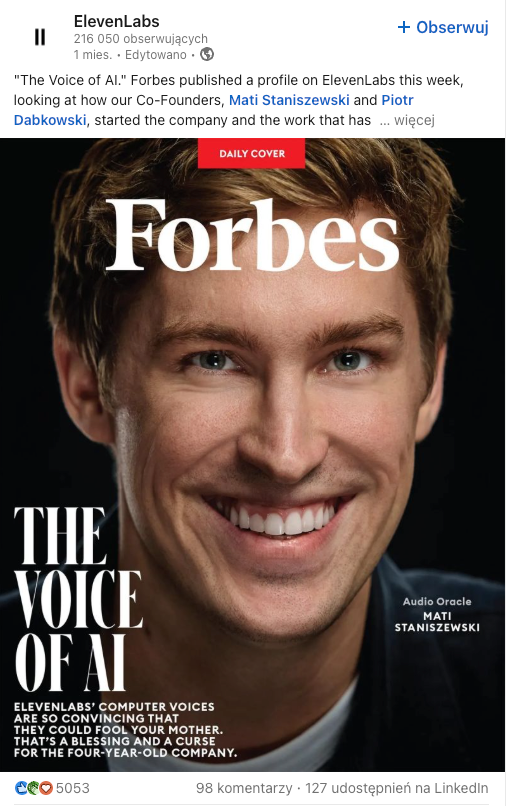
2. Hyper-Segment Your Content: Different Creatives for Different Audiences
Here's where most companies fail: they create one message and blast it everywhere.
ElevenLabs does the opposite. They create highly segmented content tailored to specific audience segments:
For Developers:
- Technical documentation walkthroughs
- API integration tutorials
- Code snippets and GitHub repos
- Performance benchmarks and latency stats
- Developer-focused feature announcements
For Content Creators & Publishers:
- Audiobook creation workflows
- Podcast production use cases
- Voice cloning demonstrations
- Time-saving testimonials
- Creator success stories
For Marketers & Agencies:
- Ad voiceover cost savings
- Localization at scale
- Brand voice consistency
- ROI calculators
- Enterprise case studies
For Media & Entertainment:
- Character voice creation for games
- Film dubbing and localization
- Animation voiceover workflows
- Celebrity voice partnerships
- Production studio integrations
Each segment gets content that speaks their language, solves their specific problems, and demonstrates relevant use cases. A game developer doesn't care about podcast workflows - they want to see character voice creation. This level of segmentation becomes critical especially in B2B marketing, where generic messaging often fails due to the insight gap in AI-generated ad creative.
This is where tools like Blumpo (try for free on https://blumpo.com/) become essential. Managing dozens of creative variations across platforms and segments is impossible manually - a challenge we explore in our AI ads creative landscape guide. Blumpo enables rapid creative production and testing - helping teams like ElevenLabs generate developer-focused LinkedIn ads, creator-focused TikTok content, and marketer-focused case studies simultaneously. Content segmentation at scale requires creative velocity at scale.
3. Build an In-House Content Creation & Animation Team
ElevenLabs made a strategic decision early: bring content production in-house.
Instead of outsourcing to agencies or freelancers, they built an internal team of videographers, animators, designers, and content producers who understand the product deeply and can move at the speed of product development.
Why this matters:
Speed: When you launch a new feature, you need demo videos, social assets, and tutorials immediately - not in three weeks after agency review cycles.
Quality: In-house teams develop brand fluency. They understand the voice, the aesthetic, the technical nuances. Every piece of content feels cohesive.
Cost efficiency: The marginal cost of each additional piece of content approaches zero once you have the team. Agencies charge per project; internal teams scale output.
Iteration velocity: A/B testing creatives requires fast iteration. In-house teams can produce 10 variations in the time it takes an agency to deliver one.
ElevenLabs' content quality is immediately recognizable - clean animations, consistent branding, professional production value. That doesn't happen by accident. It happens when you invest in the infrastructure to produce great content daily, not quarterly.
4. Launch Products Frequently and Loudly
ElevenLabs treats every product launch like a major event - because they make it one.
They don't quietly ship features and hope people notice. They orchestrate loud, coordinated launches across every channel:
- Founder announcement on X with demo video
- Product Hunt launch with community mobilization
- YouTube tutorial from their team
- Blog post with technical deep-dive
- Email to entire user base
- Discord announcement with live Q&A
- Press outreach to tech media
- Influencer and creator early access
And they do this frequently. New voices, new features, new integrations, new languages - there's always something new, always something to talk about.
The compounding effect of frequent launches:
Each launch brings a wave of attention, new signups, and social proof. But launches also train your audience to pay attention. When people know you ship fast and announce boldly, they stay engaged. They don't want to miss the next thing.
Compare this to companies that launch once a quarter with minimal fanfare. Their audiences forget they exist between launches.
Pro tip: Even small features can be "launched" if positioned well. Don't just ship - make it an event. Give it a name, create assets, tell the story behind why you built it.
5. Leverage User-Generated Content & Community Showcases
ElevenLabs' users create their best marketing for them.
Every day, creators share mind-blowing examples of what they've built: audiobooks narrated in famous voices, podcast intros with custom AI announcers, video game characters with unique voices, multilingual content without hiring voice actors.
ElevenLabs systematically amplifies this user-generated content:
- Reposting standout examples across social channels
- Featuring creators in case studies and spotlights
- Running community contests and challenges
- Creating dedicated hashtags for discoverability
- Building a public showcase gallery on their website
Why UGC is their growth multiplier:
Social proof at scale: One company saying "our product is great" = marketing. Thousands of users showing what they built = proof.
Inspiration for new users: Seeing what's possible sparks ideas. A podcaster sees someone's audiobook workflow and thinks "I could use that for my show."
SEO and discoverability: Every piece of UGC is another entry point for discovery. Someone searches "AI voice for audiobook" and finds a creator's tutorial using ElevenLabs.
The smartest companies don't just create content - they create the conditions for their community to create content for them.
6. Partner with Creators and Influencers for Authentic Demonstrations
ElevenLabs doesn't just sponsor influencers - they partner with them to create genuinely valuable content.
They identify creators in their target niches (tech reviewers, content creators, productivity YouTubers, game developers) and give them early access to new features. The creators then produce authentic reviews, tutorials, and demonstrations. For brands exploring this channel, it's also useful to understand how much influencers actually cost across different cooperation models.
The key difference from traditional influencer marketing:
Authenticity: These aren't scripted ads. Creators are genuinely using the product and showing real workflows.
Educational value: A 15-minute tutorial from a trusted creator is worth more than 100 banner ads.
Audience targeting: By partnering with niche creators, they reach highly relevant audiences. A game dev YouTuber's audience is full of potential game dev customers.
Longevity: These videos become evergreen assets that continue driving traffic and conversions for months or years.
Recent example: when they launched their voice cloning feature, they partnered with tech YouTubers to create "I cloned my voice with AI" videos. Those videos collectively drove millions of views and thousands of signups - organically.
7. Invest in Education and Thought Leadership Content
ElevenLabs doesn't just sell AI voice - they educate the market on what's possible.
They publish extensive educational content:
- "The Complete Guide to AI Voice for Audiobooks"
- "How to Localize Content with AI Dubbing"
- "Voice Cloning Ethics and Best Practices"
- "The Future of Voice in Gaming"
- Technical whitepapers on their AI models
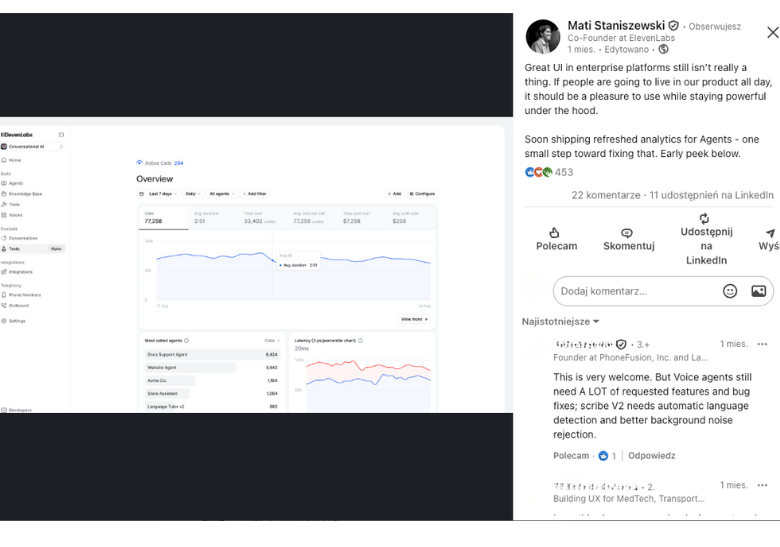
This serves multiple purposes:
SEO dominance: They rank for every educational query in their category. Someone googling "how to create AI audiobook" finds ElevenLabs content.
Buyer education: Many potential customers don't fully understand AI voice yet. Educational content brings them up to speed while positioning ElevenLabs as the expert.
Trust building: Transparent, educational content builds credibility. They're not hiding how the technology works - they're explaining it.
Lead generation: Educational content captures early-stage interest before someone is ready to buy.
The companies that educate their market own their market. When you teach someone how to solve their problem, they buy your solution. Educational content also helps brands position themselves within the rapidly evolving AI advertising ecosystem.
8. Optimize for Virality with Product-Led Moments
ElevenLabs built virality into the product itself.
Every time someone uses ElevenLabs to create audio, there's a natural share moment. They just created something cool - a voice clone, a character voice, a multilingual narration - and they want to show it off.
ElevenLabs makes sharing effortless:
- One-click social sharing from the platform
- Embedded players that showcase the ElevenLabs brand
- Watermarking on free tier (natural attribution)
- Public project galleries
- "Made with ElevenLabs" badges
The viral loop:
User creates something → shares it → friends see it → friends sign up → they create and share → cycle repeats.
This is product-led growth at its finest. The product itself becomes the marketing channel. Every piece of content created is a potential acquisition asset.
Compare this to traditional B2B SaaS: Most products have no natural share moment. ElevenLabs' users are creators - they share by nature. Tapping into that instinct turns every user into a marketer.
9. Aggressive Experimentation with New Platforms and Formats
ElevenLabs doesn't wait for platforms to become "proven" before experimenting - they're early adopters.
Recent platform bets:
- Early on TikTok before it was standard for B2B tech companies
- Instagram Reels for short-form demos and tips
- YouTube Shorts for bite-sized tutorials
- Threads for real-time community engagement
- LinkedIn carousels for B2B storytelling
Format experimentation:
- Interactive voice demos on website
- AI-generated podcasts featuring their tech
- Live-streamed product development sessions
- AMAs with founders and product team
- Collaborative content with other AI tools
The experimentation philosophy:
Not every experiment works. That's fine. The ones that do work can become massive growth channels. TikTok might be 5% of effort but 30% of awareness impact for certain segments.
The companies that win are the ones willing to try new things before they're obvious. By the time a platform is "proven," it's also crowded and expensive.
10. Build for Ecosystem Lock-In Through Integrations
ElevenLabs isn't just a standalone tool - they're building an ecosystem.
Strategic integrations include:
- Native plugins for video editing software (Adobe, DaVinci Resolve)
- API integrations for content management systems
- Partnerships with audiobook platforms
- Embeds for gaming engines (Unity, Unreal)
- Workflow integrations with marketing tools
Why this matters for growth:
Reduced friction: When ElevenLabs is already inside the tools users work in daily, adoption becomes seamless.
Network effects: Every integration is a new distribution channel. Adobe users discover them through the plugin marketplace.
Switching costs: Once someone's workflow depends on ElevenLabs integrations, they're unlikely to switch competitors.
Partner co-marketing: Integration partners promote ElevenLabs to their user base and vice versa.
The most valuable companies don't exist in isolation - they become essential infrastructure. When you're embedded in other people's workflows, you become indispensable.
The ElevenLabs Growth Formula: Synthesis
ElevenLabs' explosive growth isn't accidental - it's the result of executing a sophisticated, multi-channel growth strategy:
Foundation:
- In-house content creation team for velocity and quality
- Broad marketing mix across X, Instagram, TikTok, LinkedIn, YouTube
- Hyper-segmented content for developers, creators, marketers, publishers.
Amplification:
- Frequent, loud product launches treated as events
- User-generated content and community showcases
- Strategic creator and influencer partnerships
Sustainability:
- Educational thought leadership for SEO and trust
- Product-led viral moments and sharing
- Platform and format experimentation
- Ecosystem integrations for lock-in
The throughline: Everything connects back to content velocity, audience segmentation, and relentless shipping.
They're not trying one or two tactics - they're orchestrating all of them simultaneously. That's what separates category leaders from everyone else.
And with tools like Blumpo enabling creative diversity at scale, companies can finally match this level of segmentation and volume. You can't compete with ElevenLabs' playbook if you're stuck creating 3 pieces of content per month. You need 30. Across platforms. Across segments. With constant iteration.
The question isn't whether this approach works - ElevenLabs proves it does. The question is: can you execute it?
Sources: